
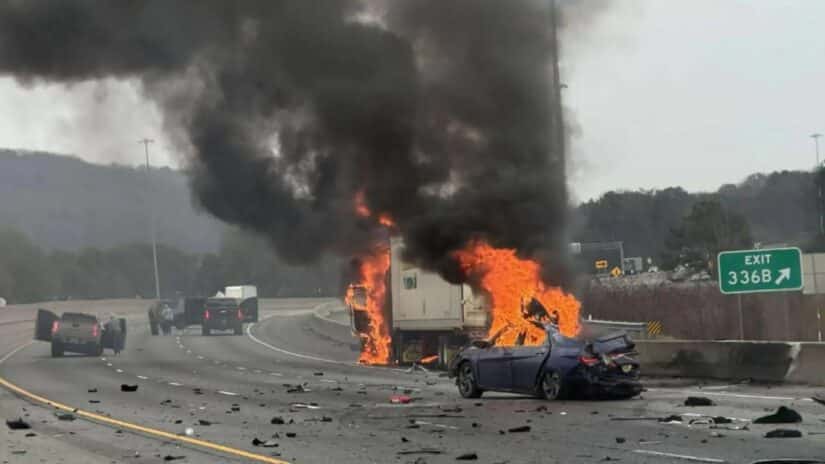
A fiery wrong-way collision on Interstate 75 in north Georgia left three people dead and shut down the interstate for hours on Thursday. Officials confirmed that a vehicle traveling the wrong direction in the southbound lanes collided head-on with a tractor-trailer, causing the car to burst into flames. Investigators are still working to determine why the driver entered the interstate incorrectly and what unfolded during the police chase that preceded the impact, a tragic scenario often examined by experienced Truck accident lawyers handling serious wrong-way and high-speed collision cases.
This tragic event reflects a growing pattern of roadway safety challenges across the region. From Georgia’s major interstate corridors to South Carolina’s rural roads and heavily traveled areas like Berkeley County, wrong-way collisions, lane-crossing incidents, and high-speed impacts continue to cause severe injuries and fatalities.
Crash Overview: Wrong-Way Driver Impact on I-75
Authorities reported that deputies were chasing a vehicle before it entered the southbound lanes of Interstate 75 in the wrong direction. The crash occurred near Exit 345, beginning in Catoosa County and extending into Whitfield County. As the fleeing vehicle continued against traffic, it struck a tractor-trailer head-on.
The violent impact caused the car to erupt into flames. The three individuals inside the vehicle were killed instantly. The tractor-trailer driver survived, and no other injuries were reported.
Officials stated that the interstate remained closed until shortly before 2 p.m., but the congestion and backup on I-75 would take additional hours to clear. Traffic was diverted to Highway 41 as emergency response teams worked at the scene.
A Regional Pattern of Roadway Danger
Even though this crash occurred in Georgia, similar roadway safety concerns have affected nearby states. For example, South Carolina has experienced multiple high-profile fatal crashes, including a deadly incident involving Jessica Nicole Way in Berkeley County. That collision on Highway 52 near Lake Moultrie involved a Honda SUV and a GMC Acadia SUV, and was investigated by the South Carolina Highway Patrol, Highway Patrol, and the Berkeley County Coroner’s Office.
Both states share several common factors contributing to traffic fatalities, including:
- high-speed rural roads
- dangerous curves and intersections
- mechanical issues
- vehicle failure
- driver fatigue
- limited visibility
- rapid emergency response needs
Georgia’s I-75 crash and South Carolina’s most recent tragedies show how roadway safety is a regional issue, not limited to one state.
Wrong-Way Driving: Why These Crashes Are Often Catastrophic
Wrong-way collisions create some of the deadliest crash scenarios. Even defensive driving techniques offer limited protection because oncoming drivers have only seconds to react.
Factors that increase fatal outcomes:
- High closing speeds
- Large commercial vehicles like a 2021 tractor trailer or Volvo tractor trailer
- Lane-entry confusion at night
- Fires triggered by fuel tank ruptures
- Mechanical issues that prevent corrective maneuvering
Investigators also consider whether toxicology results, seatbelt laws, or vehicle inspections impact outcomes.
Investigation Process: How Authorities Approach Deadly Crashes
Wrong-way crashes require detailed accident investigations, often involving several agencies. Georgia investigators will review the scene similarly to how South Carolina authorities conduct inquiries through:
- South Carolina Highway Patrol
- Coroner’s Office
- South Carolina Coroner’s Association
- Fatal Accident Investigation Team
- Berkeley County EMS
Though outside of Georgia, these agencies set examples of how multi-layered investigations work.
Investigative steps may include:
- Autopsy report review
- Forensic autopsies
- Toxicology results
- Vehicle inspections
- Mechanical issues analysis
- Roadway conditions assessment
- Social media reviews for pre-crash behavior
- Emergency response timelines
Investigators also assess whether roadway design, construction projects, rural roads, or traffic diversion contributed to the severity of the crash.
Traffic Closures and Emergency Response Complexity
Following the crash, law enforcement directed southbound travelers toward Highway 41, while Georgia State Police emphasized crisis management and urged drivers to seek alternate routes if traveling toward Atlanta.
Similar large-scale responses happen across South Carolina. Examples include closures along:
- Highway 17A
- Calestown Road
- Gumville Road
- Willow Haven Lane
- U.S. 52
- U.S. 17-A
Emergency response teams in places like North Charleston, Charleston County, and Berkeley County Sheriff’s Office regularly manage such scenes, coordinating fire departments, EMS, medical examiner offices and community outreach units.
Comparing Fatality Trends Across Georgia and South Carolina
Georgia’s wrong-way collision comes in the middle of rising regional fatalities. In South Carolina, recent years have shown persistently high numbers, with statewide data tracked by agencies including:
- National Highway Traffic Safety Administration
- Insurance Institute for Highway Safety
These organizations help states evaluate roadway safety, defensive driving education, rural roads risks and vehicle failure trends.
Public memorials, community resilience efforts and support programs like the Victim-Witness Assistance Program often emerge after such tragedies.
Why Wrong-Way Crashes Often Involve Fires
The I-75 crash vehicle burst into flames, a common result in high-speed, head-on collisions with commercial trucks. The combination of:
- fuel tank impact
- ruptured lines
- electrical shorts
- pressure changes
can trigger immediate ignition. Fire-related fatalities lead to longer identification timelines, as seen in past incidents requiring cremation permits or detailed coroner’s reports.
South Carolina Parallels: Lessons From Recent Crashes
The crash involving Jessica Nicole Way highlighted how quickly lane-crossing events can turn fatal. Agencies like the Berkeley County Coroner’s Office, Berkeley County EMS, and the South Carolina Coroner’s Association often work together on these events.
Both states confront challenges involving:
- roadway safety
- emergency response capacity
- accident investigations
- mechanical issues in vehicles
- defensive driving education
These lessons apply broadly across state lines.