
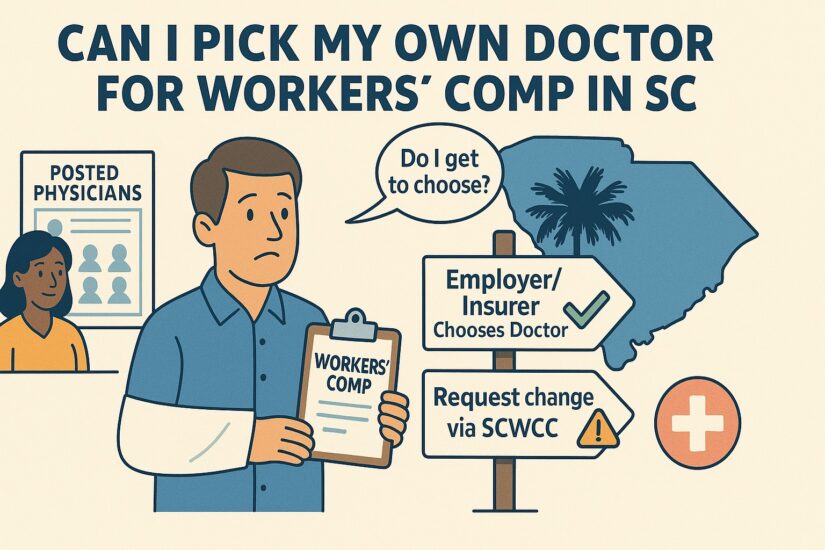
Short Answer: You can’t freely choose your own doctor in a SC WC case; your employer or insurer decides, though exceptions and dispute options exist via the Commission
Long Answer: When workers are injured on the job in South Carolina, one of the first questions they ask is: Can I pick my own doctor for workers’ comp? Many injured employees often seek guidance from a Charleston WC lawyer to better understand their rights. Medical treatment is one of the most critical aspects of any claim. The right treatment helps workers heal, but it also plays a direct role in how their benefits are managed.
In South Carolina, the short answer is no in most cases, you cannot pick your own doctor under the state’s workers’ compensation system. Instead, your employer or their insurance carrier usually controls which physician you can see for covered treatment. But as with many legal issues, there are important exceptions, practical considerations, and strategies for navigating this system.
This blog explores how medical providers are assigned in South Carolina workers’ compensation cases, what rights you do have, and what you can do if you are unhappy with your assigned doctor.
Employer Control in South Carolina Workers’ Comp
South Carolina law gives employers and their workers’ compensation insurance carriers the authority to select the treating physician. That means if you’re hurt on the job and want your medical care covered, you typically must see the doctor chosen by your employer’s insurance company.
The reasoning is simple: because the insurance company is paying for the treatment, they want oversight on the cost, type of care, and potential long-term recommendations. This control often causes tension between injured employees who want a trusted family doctor and insurers who prefer network providers.
What Happens if You See Your Own Doctor?
If you decide to see your own doctor without prior approval, the insurance company can refuse to pay for the treatment. This is one of the most common surprises for injured workers. Even if your doctor provides excellent care, the bills may become your personal responsibility unless the treatment is authorized.
That said, your doctor’s notes and findings may still be useful evidence in your claim. If a dispute arises about your condition, disability rating, or future medical needs, an independent opinion even one not initially authorized can sometimes be brought into consideration during hearings.
Exceptions to the Rule
While employer control is the general rule, there are several important exceptions:
1. Emergency Situations
If you suffer a serious injury and need immediate care, you can go to the nearest emergency room. Emergency responders are not going to stop and ask which provider your employer’s insurance company prefers. In these cases, the insurance company is typically required to cover the cost of emergency treatment.
2. Referrals from the Authorized Doctor
If the authorized physician refers you to another provider such as an orthopedic surgeon or physical therapist this referral is covered. While you can’t choose the doctor directly, you may gain access to the care you need through this process.
3. Requests for a Change of Doctor
If you feel that your assigned doctor is not listening, not providing appropriate care, or minimizing your condition, you can request a change. While approval is not guaranteed, the South Carolina Workers’ Compensation Commission can review disputes about medical care.
4. Independent Medical Examinations (IMEs)
In some cases, you may be entitled to an independent medical examination if there is a dispute about your condition, your ability to work, or your permanent impairment rating.
Why Medical Choice Matters
The ability to choose a doctor matters because medical opinions influence every part of a workers’ comp case:
- Diagnosis: Determines whether your injury is clearly work-related.
- Treatment Plan: Dictates whether you get surgery, therapy, or medications.
- Work Restrictions: Impacts whether you can return to work light duty or must remain out.
- Permanent Impairment Ratings: Directly affect the amount of compensation you may receive.
When the doctor is selected by the insurance company, workers often worry that their care will be influenced by cost-saving measures rather than patient well-being. This concern is not unfounded, which is why appeals and second opinion options exist.
The Role of the Workers’ Compensation Commission
The South Carolina Workers’ Compensation Commission acts as the referee when disputes about medical treatment arise. If an employee requests a new doctor and the insurance company refuses, the Commission has the authority to step in and decide whether a change is appropriate.
This process can be complicated, but it serves as a safeguard against one-sided decision-making by insurers.
Common Worker Concerns
“What if I don’t trust the company doctor?”
You are not alone. Many workers worry that the company-assigned doctor will downplay their injuries. If you experience this, document everything. Keeping detailed notes about symptoms, treatment, and conversations can help if you need to challenge the medical opinion later.
“What if I already saw my own doctor?”
Your visit may not be covered unless it was an emergency. However, the records from that visit can still provide valuable insight into your condition.
“Can I switch after starting treatment?”
Yes, you can request a new provider, but approval requires showing that your current doctor isn’t providing proper care or that your condition is not improving.
Broader Context: Workplace Injuries and Medical Control
The issue of doctor choice is not unique to South Carolina. Across the country, states handle workers’ comp medical treatment differently. Some allow employees to choose their doctor, while others, like South Carolina, give employers more control.
In recent years, discussions about medical independence, distracted driving injuries, high-speed crash cases, and fatal incidents in workplaces have all highlighted the importance of proper medical documentation. Whether the injury happens on Washington Road in Georgia, near Caribe Drive, or in South Carolina construction sites, accurate records from assigned doctors often determine the success of a claim.
Even agencies like the Georgia Bureau of Investigation, the Virginia State Police, or the Richmond Hill Police Department highlight how injury documentation feeds into traffic deaths and work-related fatalities reports. In South Carolina, the same applies to workers’ compensation claims – medical treatment records drive the process.
Final Thought
So, can you pick your own doctor in a South Carolina workers’ compensation case? Generally, no your employer or their insurance company has the right to decide. But exceptions exist, and safeguards through the Workers’ Compensation Commission provide options when disputes arise.
Medical treatment is the backbone of your claim. From emergency responders providing initial care to doctors issuing autopsy reports in tragic work-related fatalities, the question of who provides treatment carries weight. If you feel unheard, remember that options like second opinions, Commission appeals, and careful documentation exist to protect your rights.
About Ted Law
At Ted Law Firm, Law supports workers across South Carolina and Georgia navigating the complex world of workers’ compensation. We serve families across Aiken, Anderson, Charleston, Columbia, Greenville, Myrtle Beach, North Augusta and Orangeburg.By focusing on the human side of workplace injuries and the real impact of medical decisions, Ted Law stands with families seeking fairness, dignity, and a path toward recovery. Contact us today for a free consultation