
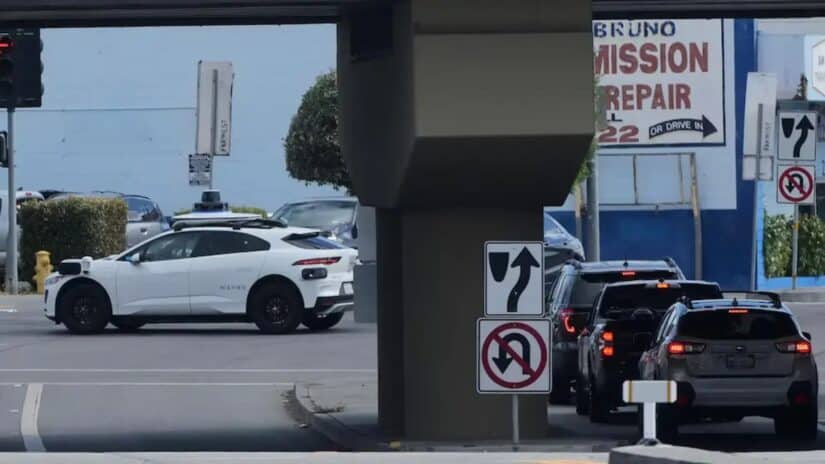
In a story that quickly went viral, police cars in San Bruno, California, pulled over a self-driving Waymo taxi after it made an illegal U-turn during a DUI checkpoint. The unusual part? When officers approached the vehicle, there was no driver inside to hold accountable. This incident highlights the legal challenges surrounding autonomous vehicles and raises pressing questions about accountability, regulation, and the future of road safety in the age of artificial intelligence.
The Incident in San Bruno
The event unfolded early on a Saturday morning when the San Bruno Police Department was conducting a DUI operation. A Waymo taxi, a fully autonomous vehicle, performed an illegal U-turn in front of officers. Naturally, they stopped the vehicle, only to find that it was operating without a human driver.
Officers documented the incident on social media, noting humorously that their “citation management books don’t have a box for ‘robot.’” The photos of an officer peering into the driverless car quickly went viral, drawing both laughter and frustration from the public.
Why Police Couldn’t Issue a Ticket
Under current California law, officers can only issue a moving violation ticket to a human driver or operator. Since the Waymo vehicle had no one behind the wheel, no citation could legally be written. While parking tickets can be left with unattended vehicles, moving violations require accountability from an actual driver.
San Bruno Police Sergeant Scott Smithmatungol explained that while the situation was unusual, the law does not currently allow for penalizing autonomous vehicles directly. A new California law, however, is set to take effect next year. It will enable officers to report moving violations committed by driverless vehicles to the Department of Motor Vehicles (DMV). The DMV’s role is similar to how agencies like the Supreme Court or legislatures handle broad interpretations of law setting precedent for accountability.
Public Reaction to the Stop
The San Bruno Police Department’s Facebook post about the incident garnered more than 500 comments. Many expressed outrage that Waymo was not held accountable for the violation. Others were more amused by the novelty of officers confronting a driverless car.
Questions also poured in: How did the police manage to stop the car? Why couldn’t the company be fined immediately? Was the technology safe enough to be on public roads if it was committing traffic violations?
The viral nature of the story illustrates how the public is grappling with the reality of driverless technology and the layers of obfuscation in current traffic laws that make it difficult to know who is responsible.
Waymo’s Response
Waymo, owned by Google’s parent company Alphabet, issued a statement through spokesperson Julia Ilina, noting that its autonomous driving system is closely monitored by regulators. The company confirmed it was investigating the incident and emphasized its commitment to road safety and continual improvement.
Some compared Waymo’s media response to how companies craft PR strategies around Bad Bunny’s concerts or other viral moments quickly addressing public opinion to manage reputation.
Legal Challenges of Autonomous Vehicles
This incident underscores the complex legal issues raised by autonomous cars:
- Accountability for Traffic Violations: If there is no human driver, who is responsible for illegal maneuvers: the car’s owner, the manufacturer, or the software developer?
- Insurance Liability: When crashes or violations occur, insurance companies and courts must determine whether the fault lies with the vehicle’s programming or other drivers on the road.
- Law Enforcement Procedures: Police officers are trained to interact with drivers. When no driver exists, procedures must be redefined.
- Consumer Protection: Regulators must balance technological innovation with public safety.
This debate resembles landmark cases like Citizens United, where interpretation of accountability changed legal landscapes.
Broader Concerns About Road Safety
While Waymo and other companies argue their vehicles are safer than human drivers, critics worry about electric cars and autonomous systems making unpredictable moves. Incidents like the illegal U-turn add to skepticism.
Some safety advocates, including veterans from places like Fort Campbell and the 101st Airborne, have voiced concerns that autonomous systems lack the discipline and decision-making needed in high-risk scenarios.
The Future of Regulation in California
The state of California has already taken steps to address the legal vacuum. Beginning next year, new legislation will allow police to report driverless vehicle violations to the DMV. The DMV will then decide how to penalize companies when their autonomous fleets break traffic laws.
This evolving framework represents an attempt to hold corporations accountable, similar to how Ohio State regulators handle safety at venues like Ohio Stadium, where public safety is always a top priority.
Public Opinion and Policy Pressure
Reactions to incidents like this are shaping national debates. Critics argue that reliance on tech firms risks creating an American Way of innovation without responsibility. Supporters counter that removing human error reduces crashes.
Community groups, including NIMBY Greens, argue that self-driving cars add congestion while offering little benefit to neighborhoods. Others see them as a tool for sustainability, replacing personal vehicles.
Final Thoughts
The Waymo incident in San Bruno illustrates both the promise and challenges of autonomous driving. It’s a story that blends humor and serious policy implications touching everything from social security for accident victims to debates in Congress where leaders like Mike Johnson, Michael Gableman, or even local voices like Hannah Broughton may influence emerging legislation.
As more driverless vehicles take to the streets, it will be critical to balance innovation with accountability, ensuring that both rich people with access to cutting-edge cars and ordinary citizens share equally safe roads.
About Ted Law
At Ted Law Firm, supports individuals and families dealing with the aftermath of vehicle-related accidents. Whether the crash involves traditional drivers, autonomous vehicles, or even cases akin to an air crash investigation, the firm is committed to helping people recover. We serve families across Aiken, Anderson, Charleston, Columbia, Greenville, Myrtle Beach, North Augusta and Orangeburg.From issues as unusual as livestock landscaping damage claims to cases involving synthetic dyes or medical concerns requiring clear separation from medical advice, the firm has built its reputation on trust, dedication, and service.Contact us today for a free consultation