
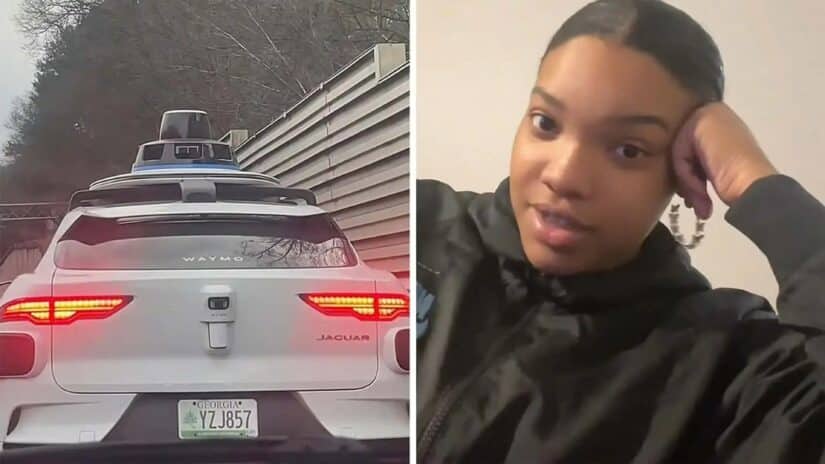
The rise of self-driving cars is changing how people travel across major cities in the United States. While companies continue to promote convenience and innovation, real-world incidents involving autonomous vehicles show that legal systems and emergency responders are still catching up.
A recent crash in Georgia involving a driverless vehicle operated by Waymo highlights this growing gap. The woman involved shared her experience online, explaining that responding officers appeared unsure how to proceed because the vehicle had no human driver, a situation a car accident lawyer may increasingly encounter as autonomous vehicles become more common on public roads.This incident has reignited national conversations around driverless car safety, accountability, and how police should respond when artificial intelligence, rather than a person, is controlling the vehicle.
What Made This Driverless Car Crash Different
Unlike traditional collisions, this accident involved a driverless vehicle with no one behind the wheel. The Waymo car, a Jaguar SUV, relies entirely on autonomous systems to make driving decisions.
When officers arrived at the scene, there was no driver to question, no license to check, and no immediate explanation for what caused the crash. This confusion mirrors challenges already seen in places like San Francisco, Los Angeles, and the broader San Francisco Bay area, where autonomous vehicles operate daily.
Law enforcement agencies across the country are still developing protocols for handling these situations.
Police Response Challenges With Autonomous Vehicles
Standard accident procedures depend on human interaction. With autonomous vehicles, those steps break down.
In cities such as San Francisco and LOS ANGELES, police departments have already reported difficulties during police stop situations involving driverless cars. In some cases, vehicles have stopped on light rail tracks, blocked intersections, or interfered with traffic lights during a power outage.
Departments like the Los Angeles Police Department and their traffic coordination division have publicly acknowledged the learning curve involved in managing these incidents.
Regulatory Oversight and Safety Concerns
Federal agencies such as the National Highway Traffic Safety Administration continue to monitor crash data involving driverless miles logged by autonomous fleets.
At the state level, California regulators, including the California Department of Motor Vehicles and the Public Utilities Commission, oversee permits and operational approvals for driverless services.
Despite oversight, critics argue that current rules do not adequately address accident accountability or emergency response expectations.
Industry-Wide Issues Beyond Waymo
Waymo is owned by Google’s parent company, but it is not the only player facing scrutiny. Companies like General Motors have also faced questions about safety testing and public road readiness.
Outside passenger vehicles, heavy-duty autonomous trucks are being tested nationwide, raising concerns among labor groups such as Teamsters California.
Publications like the Financial Times have reported extensively on these concerns, citing academic voices from institutions such as University of Cambridge and Carnegie Mellon University.
Academic and Ethical Perspectives
Experts including Andrew Maynard and researchers like Madhumita Murgia and Maya Indira Ganesh have raised ethical questions about automation risks. Studies from The George Washington University Law School discuss how liability law struggles to keep pace with machine decision-making.
Legal scholars such as Professor Robert Brauneis have referenced frameworks like the automation harms taxonomy, which attempts to classify risks created by autonomous technology.
Real-World Safety Incidents
In prior incidents, autonomous vehicles have blocked roads, ignored traffic cones, or stalled during fire department operations. Transit agencies like Valley Metro have reported interference with public transport systems.
Utility companies such as Pacific Gas and Electric Co. have also been impacted when autonomous vehicles malfunction during outages, complicating Report incident protocols listed in official User guide materials for driverless platforms.
Technology, AI, and Public Trust
As artificial intelligence expands, tools like the Gemini AI chatbot are being used to explain autonomous technology to the public. However, trust remains fragile when real-world crashes expose gaps between theory and practice.
Data repositories such as the AIAAIC Repository collect incident reports, but public confidence depends on transparency, accountability, and consistent enforcement.
Why This Georgia Crash Matters
This Georgia incident is not just about one crash. It reflects nationwide uncertainty around self-driving cars, insurance responsibility, and law enforcement readiness.
As autonomous vehicles continue to operate across states, including testing hubs in San Francisco and Los Angeles, more drivers and passengers may face similar confusion after a collision.
About Ted Law Firm
At Ted Law Firm, is a Georgia-based personal injury law firm known for advocating for individuals affected by serious accidents. We proudly represent injury victims throughout Georgia, including Atlanta, Athens, Savannah, Columbus, Warner Robins, and Macon. The firm closely follows changes in transportation laws, emerging technologies, and how evolving systems impact injured people. Contact us today for a free consultation.